

Interlinked: The Quiet Consolidation of the Internet’s Identity Layer
Exploring the $2.2B Publicis Groupe Acquisition of Liveramp


The Publicis Groupe & LiveRamp news is important for a reason I do not think enough people within the marketing industry are talking about yet, or really understand for that matter.
Most coverage is focused on the business implications of the deal itself. The valuation. The AI narrative. The strategic synergies. The data assets. The agency consolidation angle. The usual surface-level analysis that tends to accompany almost every large acquisition in advertising technology. Not to mention, Publicis has been on a fairly aggressive acquisition run over the last several years. If you’ve been paying close attention, 1a much larger strategic vision is starting to come into focus for the French Holding Company.

However, underneath all of that is a much bigger structural story about how the ad-tech ecosystem quietly organized itself over the last decade.
The people who spend time thinking about the plumbing of programmatic advertising, identity infrastructure, interoperability layers, data mobility, behavioral coordination systems, and signal persistence are likely reading this acquisition very differently than the broader market.
This stuff lives rent free in my brain, so here are a few thoughts.
“A system of cells interlinked”

Let’s calibrate for a moment. Honestly, I cannot think of a better metaphor for the industry’s most misunderstood category, and the strange structural dependencies underneath modern advertising, than the anti-empathy baseline examination from Blade Runner, designed to ensure replicants are not becoming too human.
“A system of cells interlinked within. Cells interlinked within cells interlinked...”
For years, the advertising industry publicly obsessed over browsers, cookies, privacy regulation, signal loss, ATT, and the growing power of the walled gardens. Those conversations mattered. Some still do. But while the market focused on identifiers at the edge of the ecosystem, a different and arguably more important layer of infrastructure quietly consolidated underneath it.
The real story of the last decade was the emergence of identity connectivity infrastructure as one of the internet’s most important coordination layers.
Identity itself is not new. Advertising systems have always depended on some mechanism for associating behavior, transactions, impressions, devices, and outcomes together. What changed was the scale and centrality of interoperability. Modern marketing systems no longer operate as isolated environments. Nearly every major workflow in advertising now depends on the ability to move information between fragmented systems continuously and reliably.
Media mix modeling depends on tying exposure patterns to business outcomes. Audience activation depends on translating offline customer records into addressable digital environments. Measurement depends on associating impressions, devices, and conversions across fragmented systems. Attribution systems attempt to reconstruct causality itself from behavioral continuity. Data clean rooms depend on identity interoperability to allow multiple parties to safely derive shared intelligence from overlapping datasets. Cross-platform orchestration depends on maintaining continuity of audience understanding between channels. Increasingly, AI-driven optimization systems depend on persistent behavioral memory across environments in order to function effectively at all.
Almost every meaningful advertising workflow now depends on persistent identity continuity in some form.
That dependency created an entirely new category of infrastructure, of which is continuing to evolve while major industry players seek control of the identity linkage data.
The Internet Quietly Built a New Control Layer
The simplest explanation of LiveRamp is that it became one of the connective tissue layers of the advertising ecosystem. Originally, the company’s value proposition was relatively straightforward. Brands possessed massive amounts of offline consumer information, while digital advertising systems operated in fragmented online environments with entirely different identifiers and protocols. The two worlds struggled to communicate effectively.
LiveRamp helped bridge that gap by making offline customer data operationally usable across digital systems.
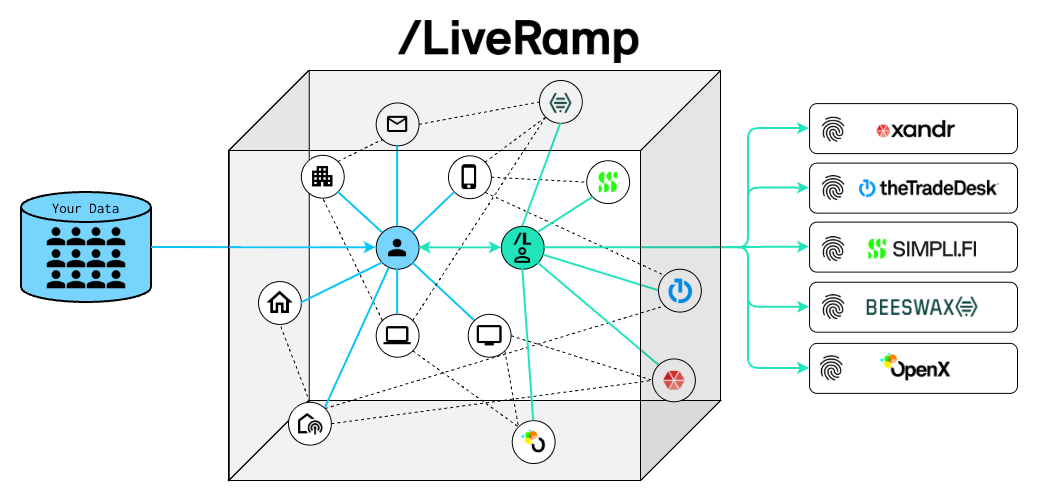
Over time, that relatively focused onboarding capability evolved into something much larger. LiveRamp became part identity graph, part interoperability rail, part data logistics layer, part clean room coordination system, and part activation infrastructure.
The company embedded itself deeply into the connective workflows of the modern advertising ecosystem. Enterprise brands operationalized around it. Agency holding companies integrated it into core workflows. Publishers monetized through it. Data providers connected into it. Cloud environments interoperated through it. Activation systems assumed its presence. Measurement systems integrated against it.
Importantly, LiveRamp’s strategic value was never really about visibility. It was about dependency.
Infrastructure businesses almost always look less impressive from the outside than the applications running on top of them. Consumers rarely think about payment rails when they buy something online. Most people do not think about cloud orchestration layers when they open an app. DNS infrastructure rarely receives public attention until something breaks. The deeper and more systemic infrastructure becomes, the more invisible it often appears.
Until someone pays $2.2B for it.
2Publicis just spent billions of dollars on plumbing.
Not a social platform. Not a creative network. Not a generative AI startup. Infrastructure.
That alone should force the industry to pause and think carefully about where strategic value has actually migrated within advertising technology. Plumbing sounds boring until you realize plumbing determines where things flow, how pressure distributes, where bottlenecks emerge, which systems interconnect, and what the ecosystem itself ultimately depends upon. The same dynamic increasingly applies to identity infrastructure.
Modern advertising now runs on the continuous movement and synchronization of behavioral understanding between systems.
Who can connect data. Who can enrich it. Who can activate it. Who can measure it. Who can transport it safely between environments. Who can maintain continuity of audience understanding across fragmented channels. These questions increasingly define the ecosystem itself.
One of the least appreciated shifts in software markets over the last decade is that interoperability itself became an economic product.
That sounds abstract until you step back and examine how fragmented enterprise marketing infrastructure actually is.
A modern enterprise may simultaneously operate CRM systems, CDPs, DSPs, clean rooms, retail media integrations, loyalty systems, cloud warehouses, commerce systems, analytics platforms, mobile SDKs, attribution vendors, publisher partnerships, offline transaction databases, identity providers, customer support systems, and internal machine learning environments. Every one of those systems produces signals. Very few naturally communicate with one another.
The entire modern advertising ecosystem increasingly depends on connective infrastructure capable of coordinating fragmented systems around persistent representations of consumers, households, transactions, devices, and behavior.
That coordination layer became one of the most strategically valuable positions on the internet.
The market largely treated those layers as neutral infrastructure. That assumption becomes much more complicated after this acquisition.
Neutral Infrastructure Eventually Becomes Strategic Infrastructure
The internet repeatedly follows a similar structural pattern.
An open ecosystem emerges. Fragmentation creates coordination problems. An interoperability layer solves those coordination problems. The ecosystem standardizes around the interoperability layer. Dependency grows. Eventually, the interoperability layer itself becomes systemic infrastructure.
Then the infrastructure becomes a strategic control point.
We have watched versions of this happen repeatedly across the modern internet. Operating systems. App stores. Cloud providers. Search distribution. Payment rails. CDN providers. Mobile ecosystems. Logistics infrastructure. API gateways. The pattern repeats because coordination itself becomes extraordinarily valuable at scale.
Advertising identity infrastructure followed the same arc, and now a new control narrative is forming.
As long as these systems were viewed as relatively neutral connective tissue, the ecosystem tolerated significant dependency concentration around them. But the strategic meaning changes immediately when one of the largest agency holding companies acquires one of the most deeply embedded interoperability layers in the advertising ecosystem.
Now the operator of the rail is also an active market participant. That matters enormously…
To be clear, this was an extremely rational acquisition by Publicis. I do not view this as irrational consolidation or some abstract defensive maneuver. I think Publicis understands something the broader market is still underestimating: the future economic leverage of advertising increasingly accrues to the systems coordinating identity continuity, behavioral memory, interoperability, activation, and optimization across fragmented environments.
Not simply campaign execution.
Not simply media buying.
Not simply creative production.
The strategic value migrated downward into the coordination layer itself.
That is where the defensibility lives now.
The advertising industry spent years competing over audiences while an entirely different battle quietly emerged underneath the surface: ownership of the systems that allow audiences, signals, transactions, and behavioral understanding to move between environments at all.
That is a much deeper layer of control.
AI Will Intensify This Dynamic Dramatically
One of the strangest narratives floating around the industry right now is the idea that AI somehow reduces the importance of identity and data infrastructure. In reality, the opposite is likely true.
AI systems become dramatically more valuable when they operate against persistent, connected behavioral memory architectures.
Think carefully about what autonomous marketing systems actually require in order to function effectively. An AI optimization environment needs historical continuity. It needs feedback loops. It needs stable identity persistence. It needs cross-platform visibility. It needs attribution continuity. It needs behavioral aggregation. It needs orchestration context.
Without continuity, intelligence fragments across environments. Optimization loops weaken. Personalization weakens. Measurement weakens. Prediction weakens.
AI agents dramatically increase the economic value of connected behavioral infrastructure because autonomous systems require stable memory architectures in order to coordinate effectively across fragmented ecosystems. This is one reason I think many people are underestimating the long-term significance of this acquisition.
Publicis is not simply buying data infrastructure for current workflows. They are buying positioning within the future coordination layer for AI-driven advertising systems.
The broader advertising ecosystem has quietly assembled something resembling a distributed behavioral coordination network spanning publishers, agencies, cloud systems, DSPs, clean rooms, transaction systems, commerce media networks, identity graphs, activation environments, measurement systems, and optimization engines. What do we mean?
Every interaction creates feedback.
Every feedback loop improves future targeting and optimization.
Every optimization loop increases dependency on continuity.
Every dependency increases the value of interoperability infrastructure.
Eventually, the connective tissue itself becomes more strategically important than many of the applications running on top of it.
That is where the market increasingly finds itself now.
The Open Web Increasingly Depends on Highly Concentrated Coordination Systems
This is where the acquisition becomes structurally fascinating.
Because infrastructure concentration changes ecosystems.
Not always maliciously. Not always intentionally. But almost always eventually.
When a connective layer becomes deeply embedded enough, it increasingly influences who interoperates, who measures effectively, who monetizes efficiently, who activates audiences seamlessly, which partners integrate easily, what workflows become frictionless, where switching costs emerge, and which ecosystems compound strategic advantage over time.
The control layer shapes the ecosystem around it.
Sometimes subtly. Sometimes aggressively. Usually gradually. Now, Suddenly.
I think this acquisition should force the entire industry to reevaluate how much of the so-called “open web” increasingly depends on highly concentrated coordination systems underneath the surface.
From the outside, the ecosystem still appears wildly decentralized. Thousands of publishers. Thousands of vendors. Endless software fragmentation. Countless integrations. Massive complexity.
But underneath that apparent fragmentation, more and more workflows increasingly converge around a relatively small number of connective systems enabling identity continuity, interoperability, activation, measurement, collaboration, and behavioral coordination at scale. Do you (brand, publisher, advertiser…) have control of your own data?
That concentration may ultimately matter more than many of the browser-level debates that dominated industry attention over the last decade.
Because ecosystems eventually reorganize around their deepest dependencies.
And in many ways, that is the real significance of this acquisition.
I suspect many people will ultimately look at the Publicis + LiveRamp deal and see an agency acquisition, a data play, an AI positioning strategy, or a holdco consolidation maneuver. Those interpretations are all directionally correct.
What I see is something slightly different.
I see a visible acknowledgment that the future strategic leverage of advertising increasingly lives inside the infrastructure coordinating identity, memory, interoperability, and behavioral continuity across systems.
The industry spent years debating the surface layer of digital advertising while the connective tissue underneath quietly became one of the internet’s most important control planes.
Publicis just paid $2.2B for part of that control plane.
In hindsight, that may end up looking inexpensive.
—
Untitled Thoughts is a space for my writing on marketing systems, identity infrastructure, data strategy, and life as a founder building in a messy, evolving landscape. I use it to share what I’m learning, what I’m seeing, and the ideas I believe more marketers should be paying attention to (Whether tactical, philosophical, or somewhere in between). If anything here resonates, I’d love for you to test drive our platform at getuntitled.ai. Your feedback makes us better.
This is a beautiful breakdown of the Publicis Ecosystem by Chris Hawk: https://chawk1634-byte.github.io/publicis-identity-stack/
Linking the Publicis Press Release on the deal here: https://www.publicisgroupe.com/en/news/press-releases/publicis-to-acquire-liveramp-to-accelerate-data-co-creation-for-smarter-agents